In Alabama, drunk driving accidents are one of the only personal injury scenarios where your case may be worth significantly more than your medical bills, because of punitive damages. This is not a technicality. It is a meaningful legal distinction that changes the entire value of what you can recover, and most victims never find out until it is too late to use it.
If you were hit by a drunk driver this Memorial Day weekend, here is what Alabama law actually entitles you to.
Why Memorial Day Weekend Is a Peak Window for Drunk Driving Crashes
The numbers are consistent every year. During Memorial Day weekend 2025, ALEA troopers made 29 DUI arrests across Alabama in just four days. The prior year, there were 6 traffic fatalities. Nationally, the National Safety Council found that 39% of Memorial Day traffic fatalities in 2023 involved an alcohol-impaired driver, compared to a 30% annual average.
Long weekends, outdoor gatherings, travel, and alcohol combine in ways that consistently produce deadly crashes. If you were hit by a drunk driver during this period, you are not alone, and the law has specific protections for people in exactly your situation.
What You Can Recover: The Full Picture
When you are injured by a drunk driver in Alabama, your potential recovery falls into two broad categories. Understanding both matters.
Compensatory Damages
These cover your actual losses. They include:
- Medical bills, both current and future
- Lost wages if you missed work during recovery
- Reduced earning capacity if your injuries affect your ability to work long-term
- Pain and suffering
- Emotional distress
- Property damage to your vehicle
Compensatory damages are the baseline. They are what any car accident victim can potentially recover. But in a drunk driving case, they are only the beginning.
Punitive Damages: Why Drunk Driving Cases Are Different
Alabama Code § 6-11-20 allows courts to award punitive damages in cases where the defendant acted with wantonness, meaning they consciously engaged in conduct knowing it would likely cause harm to others. Getting behind the wheel while intoxicated almost always meets this standard.
Punitive damages are not tied to your actual losses. They are designed to punish the drunk driver and deter others from making the same choice. Drunk driving is treated as more than ordinary negligence because it reflects conscious wrongdoing, not a lapse in attention.
Alabama caps punitive damages at three times compensatory damages or $1.5 million, whichever is greater. So if your compensatory damages total $200,000, you could potentially recover up to $600,000 in punitive damages on top of that. If the driver had a very high BAC or prior DUI convictions, a court may find the cap does not apply.

The Contributory Negligence Exception You Need to Know
Alabama’s contributory negligence rule ordinarily means that any fault on your part, even 1%, can bar your recovery entirely. This is one of the strictest fault standards in the country, and it is something insurance companies exploit aggressively. Our full explanation of Alabama’s contributory negligence law covers how this typically works.
But drunk driving cases operate differently. When a defendant’s conduct rises to the level of wantonness, the contributory negligence defense is significantly weakened or eliminated altogether. The court can find that the drunk driver’s reckless decision to drive impaired was the clear and overriding cause of the crash, regardless of what you were doing.
This matters enormously. It means that even if the insurance company tries to pin partial blame on you, that argument may carry far less weight in a DUI accident case than it would in a standard collision.
Dram Shop Liability: You May Be Able to Sue the Bar
Here is something most people do not know: if the drunk driver was served alcohol by a bar, restaurant, or liquor store before the crash, you may be able to hold that establishment liable too. This is called dram shop liability.
Alabama law allows you to sue a business that served alcohol to someone who was visibly intoxicated, and who then caused an accident. If the driver was under 21, liability can apply even if the person did not appear drunk at the time, because selling alcohol to a minor is always illegal in Alabama.
Why does this matter? Because a bar typically carries far more insurance than an individual driver. Adding a dram shop claim can dramatically increase the total amount available to compensate you. It also creates a second defendant with their own legal exposure, which often changes how quickly cases resolve and for how much.
Building a dram shop claim requires quick action. Surveillance footage gets overwritten. Receipts and credit card records disappear. If you have any reason to believe the drunk driver was drinking at a bar before the crash, contact an attorney immediately so that evidence can be preserved.

What to Do Right After the Crash
Your actions in the hours following a drunk driving crash have a real impact on your case.
Call 911 immediately. Make sure law enforcement responds and that the driver is tested for intoxication. The police report and the official BAC reading are critical evidence. Without them, building a punitive damages argument becomes much harder.
Seek medical attention the same day, even if you believe your injuries are minor. Adrenaline suppresses pain. Internal injuries and concussions often have delayed symptoms. A same-day medical record directly connects your injuries to the crash.
Do not speak to the other driver’s insurance company. After a drunk driving crash, adjusters may still attempt to assign partial fault to you. They know how to use Alabama’s contributory negligence rule, and they will try to use it even in cases where a driver was legally intoxicated. Before you say anything, read our guide on what not to say to an insurance adjuster in Alabama.
If the drunk driver had no insurance or insufficient coverage, your own uninsured/underinsured motorist policy may provide additional recovery. Our article on uninsured motorist coverage in Alabama explains how that works.
“Can I Really Afford a Lawyer Right Now?”
Yes. Chris Baldwin Law handles drunk driving accident cases on a contingency fee basis. That means there is no fee unless we win. You do not need money upfront to get experienced legal representation for what may be the most important case of your life.
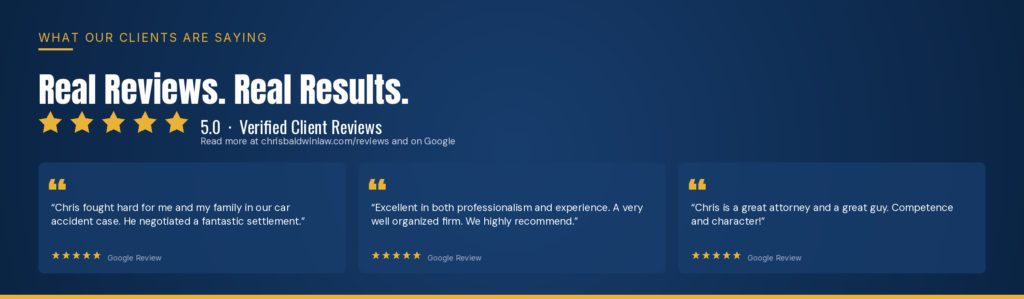
Here’s what one client had to say: “Chris provides the knowledge and expertise that I would expect from a much larger firm but with the personal one on one interaction you expect from a small firm.”
Read more client reviews at chrisbaldwinlaw.com/reviews.
You Deserve More Than the Minimum
A drunk driver made a deliberate, dangerous choice. Alabama law exists to hold that person fully accountable, not just for what they cost you, but for the recklessness itself. You may be entitled to punitive damages, dram shop recovery, and compensation for every aspect of your injury.
Call Chris Baldwin Law at (334) 863-4555, 24 hours a day, 7 days a week. You can also reach us online at chrisbaldwinlaw.com. The sooner you call, the more evidence we can preserve and the stronger your case becomes.
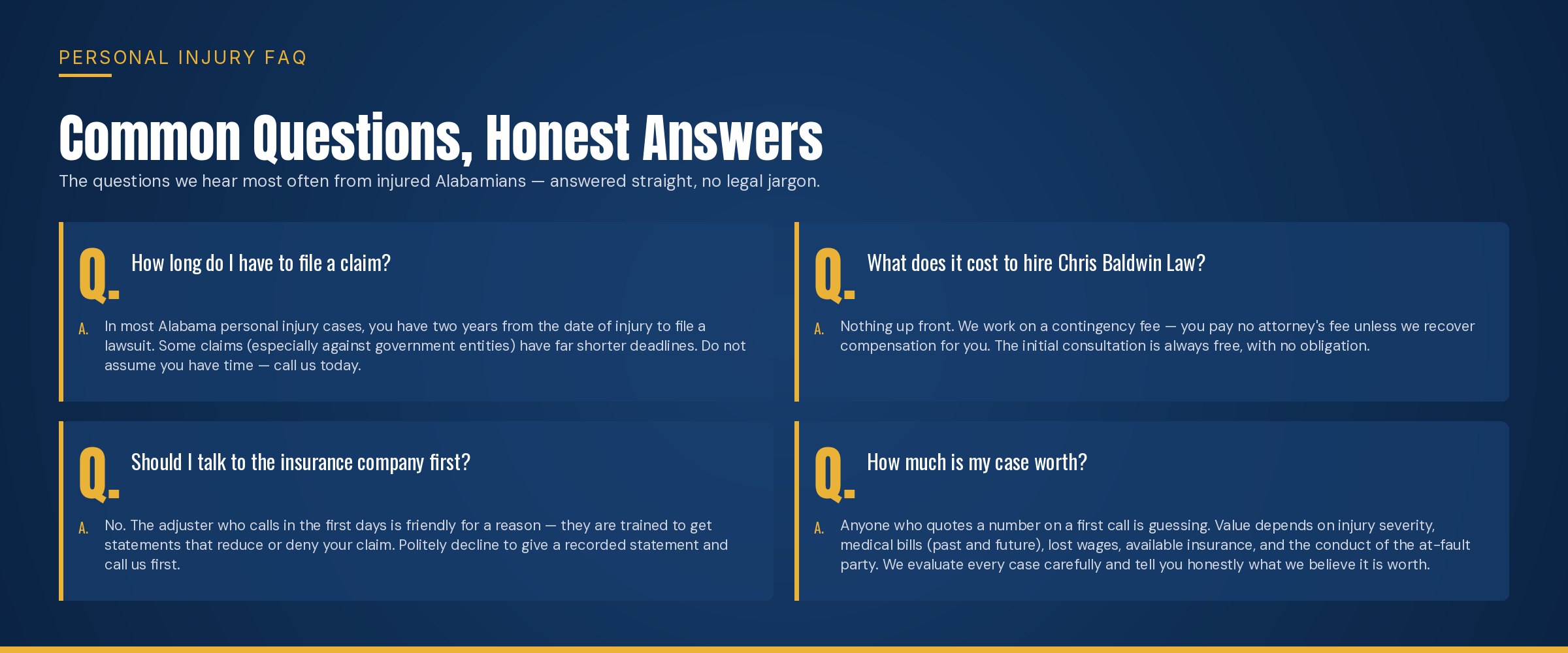
Frequently Asked Questions
Does it matter if the drunk driver was not charged with DUI?
A criminal charge is not required to win a civil case. The standard of proof in civil court is lower than in criminal court. You need to show it was “more likely than not” that the driver was impaired, which is a meaningfully easier bar to meet. An attorney can use medical records, witness statements, police observations, and other evidence to support your civil claim even if the criminal case does not move forward.
What if the drunk driver who hit me has no insurance?
This is where your own uninsured motorist (UM) coverage becomes critical. Alabama law requires insurers to offer UM coverage, and if you have it, it may cover your losses when the at-fault driver is uninsured or underinsured.
Can I still file a civil lawsuit if the drunk driver is already facing criminal charges?
Absolutely. The criminal case and your civil case are separate legal proceedings. The criminal case is the state’s case against the driver. Your civil case is about your right to compensation. Both can proceed at the same time, and a conviction in the criminal case actually strengthens your civil claim.
What is the statute of limitations for a drunk driving injury claim in Alabama?
In most personal injury cases, Alabama gives you two years from the date of the accident to file a lawsuit. Waiting too long can permanently bar your claim. If you were hurt this Memorial Day weekend, do not delay in contacting an attorney.
What if I was partly at fault? Does that eliminate my punitive damages claim?
Not necessarily. Because drunk driving constitutes wanton conduct under Alabama law, the contributory negligence defense is weakened significantly in these cases. An experienced attorney can assess whether the wanton conduct exception applies to your specific situation and fight to protect your full recovery.